

























































Is Mind Control a Reality? Move Objects with Your Mind.
-
manishgupta089
- Jun 16, 2026
- 0
- 6 min read

It’s not that long ago that moving objects using only your thoughts seemed something of a fantasy, confined to the worlds of science fiction films where heroes were seen to levitate robotic arms, open doors and fly vehicles merely by focusing their thoughts on them. Now though, that fantasy is fast becoming a reality.
The breakthroughs made in the fields of neuroscience, artificial intelligence and engineering have paved the way for humans to communicate with machines and operate devices using only signals from their brain. It’s not mind control in the supernatural sense of the word but, without a doubt, it represents one of the most astonishing technological advancements to date and is already changing peoples’ lives and potentially how we interact with technology.
What is a Brain-Computer Interface?
This new and exciting technology is called a Brain-Computer Interface (BCI). Simply put, a BCI establishes a direct pathway of communication between the brain and a digital device, essentially allowing someone to control it without any muscle movement.
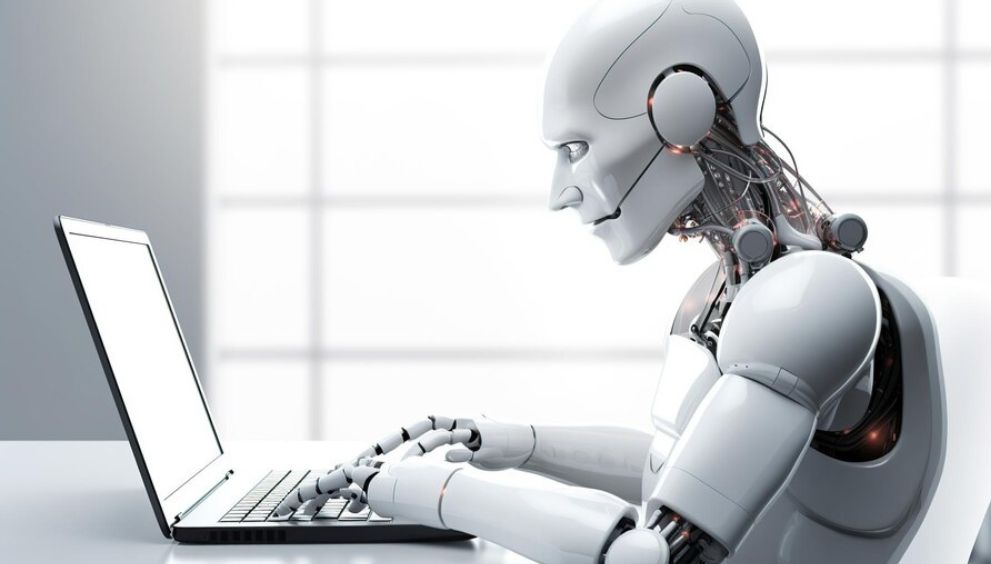
Every second, our brain is humming with the electrical signals of billions of neurons sending messages between them. BCIs read these signals with sensors, interpret the messages with the help of artificial intelligence, and then convert them into signals which a computer can understand. A user can then operate a robotic arm, control a mouse pointer or power a wheelchair by just thinking about the specific motion.
There are two ways to capture these brain signals: with the non-invasive BCI that sits on top of your scalp and records EEG signals from outside your head (which although safe and easy to use do have limitations) or the more advanced invasive BCI where tiny electrodes are implanted in the brain to create much more defined and faster signals.
Read This Also: iOS or Android: Which Is the Best Choice for Your Business and Why?
It’s the artificial intelligence which comes into play next. An AI learns to read these signals, recognize a pattern associated with an individual command (imagine moving your hand, or focusing on a certain task) and repeat this process until it learns accurately what that command means, the more it practices the quicker and more responsive it becomes.
Giving back independence
One of the most life changing applications of this technology is in healthcare.
People who have suffered from conditions such as spinal injury or a stroke lose some or all control of their muscles, even though the command for movement is coming from their brain. BCIs create an alternative pathway for these signals and enable them to be relayed directly to the required machine, such as a robotic arm, prosthetic limb or computer.
In the past few years, experiments have enabled paralyzed patients to feed themselves using a robotic arm controlled only by their thoughts; to type messages, surf the web, and even play computer games all without lifting a finger or needing a mouse and keyboard.
This is made possible with artificial intelligence which works because everyone’s signals are different; machine learning can analyse individual patterns and allow a computer program to respond in accordance to them. As the system becomes used more frequently, it adapts more to its user making the controls ever more fluid and intuitive.
Neuralink and the Next Generation of Brain-Controlled Technology
Of course, one name stands out in this relatively new field and that is Neuralink founded by Elon Musk. The firm is working on developing brain implants designed to provide people with severe disabilities with more fluid ways of communicating with digital devices through their mind alone.
There have already been human trials where participants have successfully manipulated cursors and controlled software with ease. Neuralink is just one example but has really put the technology on the map for everyone to talk about.
Looking ahead it’s expected that BCIs will revolutionise more than just healthcare. Forget the need for keyboards, touch screens or even voice activation – devices in the future will respond to your thoughts.
Being able to email without typing, fly a drone without holding a remote control or navigating virtual reality with only your mind all sound far-fetched today but the foundations for this type of interaction are all here.
Read This Also: AI Agents: Why The Next Wave In Artificial Intelligence Is Happening Now
What we can’t ignore:
This incredible technology does raise a lot of serious issues though, mainly concerned with ethics and privacy.
While your fingerprint or password tell anyone who gets access to them very little, signals from your brain could reveal so much more – how you concentrate, how you think or what your reflexes are like. As this technology gets more advanced, important questions have been asked about who would own these brain signals? How do we protect the information and stop it being misused by advertisers, intelligence agencies, or even predicting future actions of a user.
Security is another big concern. Just like any other device connected to the internet it could be hacked.
Ethical issues are also being discussed amongst governments and scientists to ensure that this type of BCI technology is used correctly and fairly for everyone.
There is another widely held misconception that BCIs can “read people’s minds.” They can’t.
Present day devices do not read minds. They pick up and interpret thought-signals which an individual is trying to relay to a computer in order to move something, operate something or type. A BCI interprets thoughts as commands so although impressive, it is very far from a mind-reading machine.
The Future Is Here
While the science is only just beginning, brain-computer interfaces are developing at a rapid pace. We’re now seeing much more accurate devices, fewer invasive treatments, and easier to wear systems. Experiments are being carried out into restoring the ability to speak, helping post-accident sufferers regain functionality and enabling near-instantaneous interaction between people and computers.
As artificial intelligence continues to advance, technology becomes more compact, brain-controlled systems will likely become ever faster, cheaper and more readily available.
It seems that the futuristic scenario of a thought-controlled world is rapidly becoming a fact.
Although we are a very long way off being able to manipulate our surroundings just by our thoughts, the fact that we can now control robotic arms, operate computers, and communicate purely through our mind, is a feat in itself.
The question is no longer whether thought-controlled technology can be achieved but rather, how far will this exciting new innovation take us.
Read this also: The Importance of Digital Marketing for Business Growth