 technicalmonks
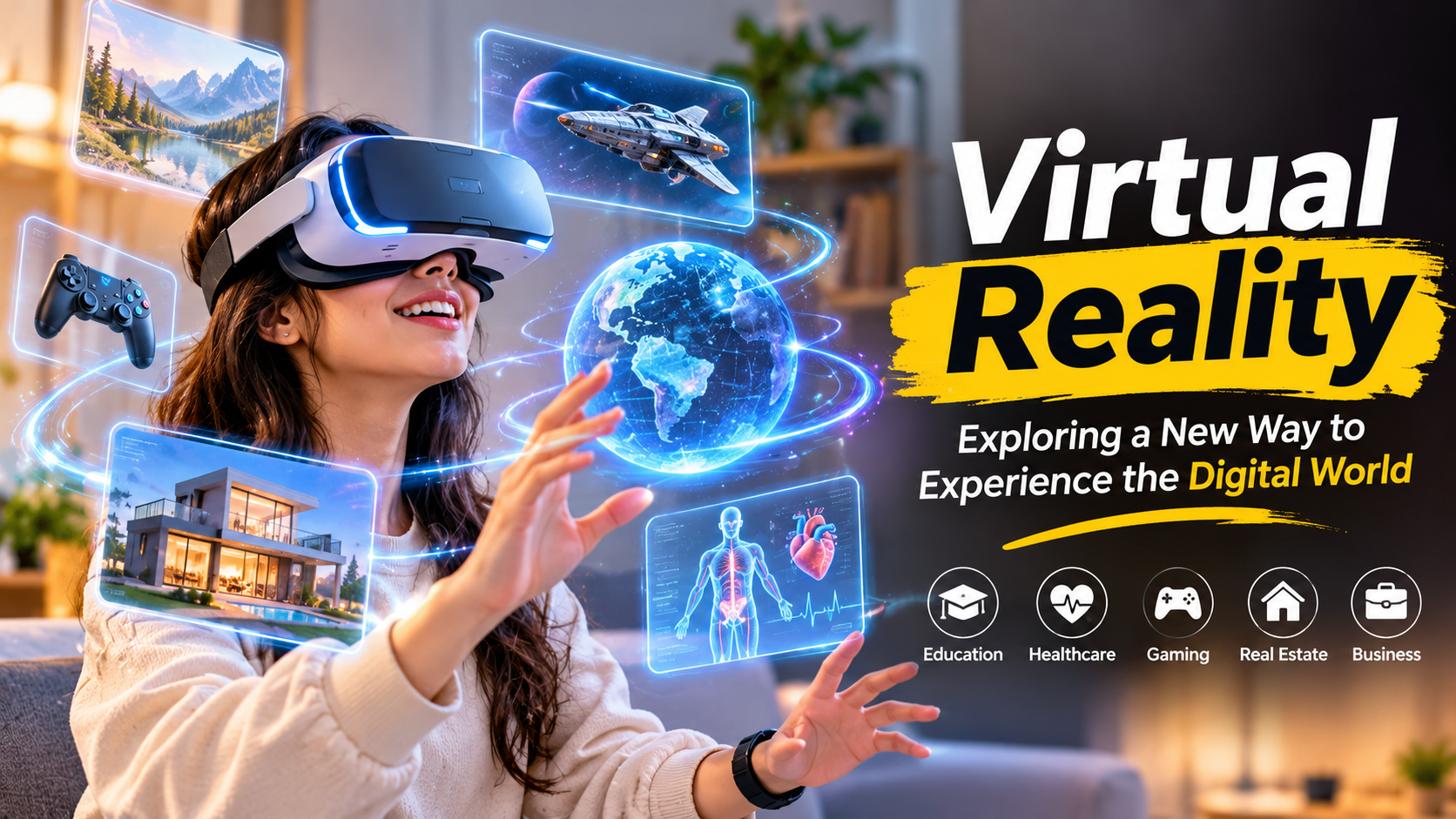
Have you ever thought about experiencing a luxury apartment abroad without leaving your home, seeing historical sites from a classroom, or training for a job without entering an office? All of this is possible thanks to Virtual Reality.
Incorporate Virtual Reality VR is redefining our experience with technology. It’s no longer about viewing information on a screen; now, you can immerse yourself in a cyberspace setting and actually play with objects there. From gaming to work training, it’s opening doors for many sectors.
What Makes Virtual Reality Different?
Virtual Reality transports the user to an artificial environment that the user interacts with using equipment, like a VR headset.
For each eye, the headset projects a different image so that the view appears three-dimensional. Head movements are detected with sensors, and objects can be manipulated with controllers.
Certain advanced systems even feature hand tracking, spatial audio, and motion sensors to further make the interaction more natural.
The major difference is presence. You are not just watching a digital environment; you are feeling that you are actually immersed in it.
In what places do we use virtual reality?
VR is slowly being adopted across different industries, not just gaming. Here are some of the surprising VR applications.
1. Education Without Physical Boundaries
Students may investigate a historical site, look at a scientific model, or participate in a simulated laboratory experiment. They can learn without always using a textbook.
This helps students understand something in a complex subject.
2. Healthcare Training and Rehabilitation
Practice of simulated procedures is available for medical students in simulated environments. Healthcare workers may also use this form of training and can also try out some of the selected rehabilitation activities.
These give more study opportunities, but should always be given by professional human staff.
3. Real Estate Virtual Tours
Area viewers have the chance to walk through homes, apartments, and commercial properties via virtual tours. Potential buyers can review room plans and floor plans of the interior of a home without initially driving out to the property.
Builders and architects can also show digital models of a building prior to the start of construction.
4. Gaming and Entertainment
One of the most popular applications of VR is gaming, allowing users to enter and interact with game environments.
Virtual events, exhibitions, and interactive narratives are also areas of investigation.
5. Employee Training
Few people prefer collaboration; in reality, you need it. Think about it in terms of how VR technology can train employees for various job circumstances. For instance, manufacturing firms might utilize virtual reality to simulate training on the machinery.
These kinds of simulations enable employees to learn by doing, without having to create all of the real-life scenarios.
VR vs AR: What Is the Difference?
Reality and Augmented Reality: Virtual Reality and Augmented Reality are related terms.
In VR, the world around the user is replaced with a computer-generated world. Augmented Reality (AR): In AR, the world around the user is augmented with computer-generated information.
For instance, VR might immerse a person within a virtual classroom, and AR might show a person instructions overlaid on top of a real machine.
Both solutions present unique possibilities based on the experience a business is aiming to provide.
Why Are Businesses Exploring VR?
Virtual Reality opens up a new world for companies to demonstrate products, train their staff, and communicate.
A furniture maker might offer a virtual showroom for customers to view various room configurations. A construction firm might allow customers to walk through building designs prior to construction.
Just as for processes, simulations can be utilized for educating organizations on things such as workflows.
Nevertheless, it’s important to consider the cost of equipment, software requirements, and customer demand and practicality before purchasing VR for your business.
Issues That Still Need To Be Addressed
Even though usage is improving.
- More sophisticated headsets and supporting technology can be costly.
- User Comfort: Eye strain, dizziness, or motion sickness for some users.
- Technical Skills: Skills in this area are necessary when creating a virtual environment.
- Accessibility: Not everyone owns compatible equipment.
- Good VR experiences necessitate good software and continuous updates.
This will need to be tackled if it is to be widely adopted.
What Does the Future Hold for Virtual Reality?
Virtual Reality is, in the distant future, possibly going to get lighter headsets with more engaging and better displays, more accurate tracking, and more natural interaction techniques.
It might make simulated realities smarter by integrating intelligent characters.
You could also consider VR to help run remote meetings, showcase products, and support employee training.
As hardware becomes more ubiquitous and more practical applications are created, immersive tech could become a part of our digital lives.
Commonly Asked Questions
Is Virtual Reality only used for gaming?
No. VR is utilised in training, HR, education, medical, real estate, and manufacturing.
Can Virtual Reality work without a computer?
Yes. There are both stand-alone and tethered headsets available.
How is VR different from AR?
Yes. VR involves creating a virtual environment, while AR consists of layering virtual images and sounds on the real-world environment.
Final Thoughts
Virtual Reality is pioneering a new dimension of access to digital information, simulating, practicing, and engaging with content in new ways.
Despite the high costs of equipment and its limited access at present, the uses of this immersive technology across various industries have been quite promising. The big opportunity for businesses in this area lies in finding innovative ways to make use of immersive tech to enhance learning, products, and customer engagement.