 technicalmonks
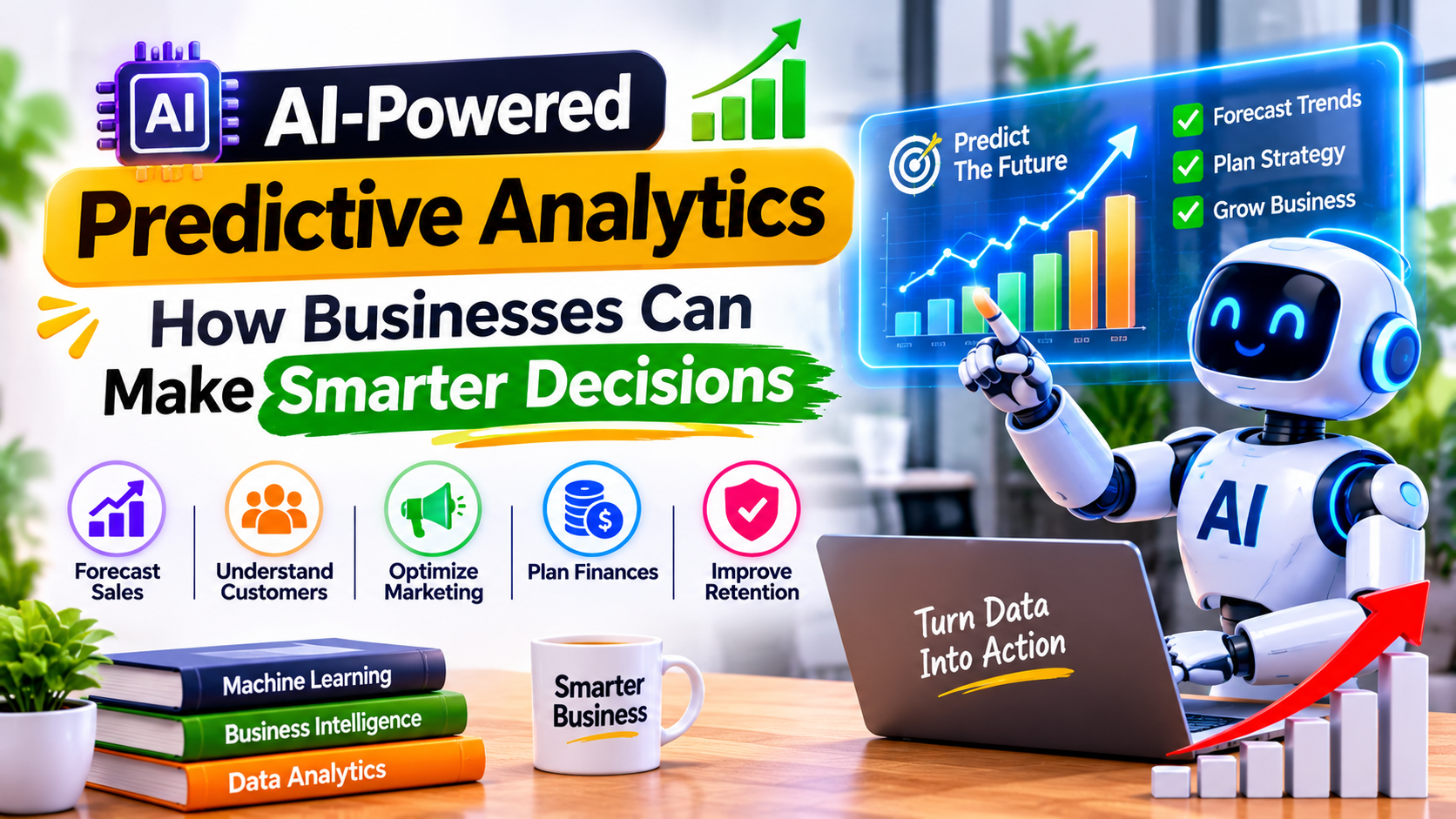
Companies produce vast stores of data on a daily basis, from website visits and customers buying online to searching for and purchasing products through marketing campaigns and sales. Knowing what to do with the information can give a business an edge and help it prepare for what’s to come. But it can take a while to do all that analysis. That’s where AI-powered predictive analytics comes in.
Artificial Intelligence. Rather than blindly following historical data or making assumptions, businesses are now able to use these sophisticated predictive systems to analyse data for trends, project outcomes, and make better business decisions. This has applications in customer demand forecasting and improved marketing strategies.
What Is AI–Powered Predictive Analytics?
Predictive analytics using AI is the calculation of what could happen in the future by leveraging AI, ML, statistical techniques, and historical data.
Conventional data analysis describes what we observed. Predictive analytics goes to the next level by discovering trends.
For instance, an online clothing shop can predict upcoming sales seasons based on past bought items, seasonal demand, visitor preferences, and website activity.
These predictions are not guaranteed results. The data-based predictions must assist firms to plan and decide.
In what way does AI enhance Predictive Analytics
AI enhances predictive analytics by giving systems the ability to analyse and understand complex patterns across large data sets.
Below are some key ways that AI enhances this process:
1. Identifying Hidden Patterns
AI models can analyse massive amounts of data, drawing associations that human analysts may not recognise right away. These connections can provide insights into customer preferences, sales behaviour, and market changes.
2. Processing Data Faster
Many organisations have a number of data sources. With AI-enabled processes, an organisation can analyse vast amounts of data faster, so teams don’t have to spend as much time analysing it.
3. Improving Predictions Over Time
New data can be used to test and revise machine learning models. If well maintained, a model will be able to accommodate shifting trends and enhance the accuracy of future estimates.
4. Supporting Data-Based Decisions
With AI-generated forecasts, your managers have more information to base their budgets, inventories, marketing campaigns, and business plans on.
Business Uses Of Predictive Analytics
AI-powered predictive analytics can be used in many ways. The benefit is really based on the data that’s available and the nature of the business problem.
1. Sales and Demand Forecasting
All retailers and online stores must know how much inventory they may need to have in the upcoming weeks and months. Analytics can look at historical sales, seasonal trends, promotions, and customer requests.
This allows companies to forecast how much stock they will need and can prevent the likelihood of losing out on bestsellers or being burdened with too much stock.
2. Understanding Customer Behaviour
Organisations can analyse customer conversations to infer purchasing behaviour or preferences. AI models can recognise customers who are likely to buy a product or service.
These insights can assist companies in delivering more meaningful offers and better customer experiences and in arriving at more targeted communications.
3. Marketing Campaign Planning
Put predictive analytics to work by estimating the potential reaction of different audiences to a specific campaign. Past campaign results, web traffic, and how people interact with you can all offer valuable insights.
For example, an e-commerce business might analyse past campaign data to determine which customer segments are more likely to react to the seasonal sale.
4. Financial Planning
Financial teams can use predictive models to estimate costs, revenue trends, and cash flow needs for forecasting and budgeting to anticipate various financial scenarios.
But keep in mind that any forecast should be considered in the context of the marketplace and a trained financial professional’s assessment.
5. Customer Retention
Generating new customers is great. But holding onto current customers will make your business grow at the same rate over time. Existing customers can be analysed for things like engagement levels, rate of purchases, and more customer service interactions.
These could be signals to a business that a customer is struggling and might require a bit more assistance or a better experience.
Favourite Tools for Predictive Analytics
Many solutions offer data analysis and model building capabilities. Which solution is suitable for your use case depends upon the data volume, technical skill, budget,t and the requirement.
- Allows companies to analyse data, generate reports, and browse for trends using available dashboards.
- Google Cloud BigQuery ML: enables users to create and run machine learning models on data stored within BigQuery.
- Amazon SageMaker: Offers applications that assist in building, testing, and applying machine-learning models.
- IBM watsonx: Provides an environment for enterprise data, AI, and ML.
- Python: Data processing and predictive modelling are enabled by prominent programming libraries such as pandas, scikit-learn, and TensorFlow.
When selecting the platform, businesses should compare features, cost, security requirements, and integration options.
Challenges Businesses Should Consider
While predictive analytics can provide valuable opportunities, it cannot be deployed without a thoughtful approach.
Data quality: Missing, old, or inaccurate data may also lead to lower levels of prediction accuracy. Companies need to maintain and update their data constantly.
Privacy and Security: Customer data should be acquired and processed responsibly and, where relevant, in accordance with regulations relating to privacy.
Model Bias: A model can perpetuate biased historical data. Feedback and testing can detect these issues.
Cost to Deploy: Certain specialised products will need technological assistance, platforms, and maintenance costs. Businesses should look at potential benefits before making a purchase decision.
Human involvement: Predictions are intended to be aids in decision-making. Managers need to think about what the model has not learnt about the real world.
Getting Started with Predictive Analytics for Small Businesses
You do not need to be a large organisation to utilise predictive analytics. Small companies can start off easily and then build their expertise.
The first step is to decide on one business issue, like predicting monthly sales or exploring customers’ buying habits. Then gather information from trusted sources like analytics on your website and sales history.
Start by selecting an analysis tool to use, then start with a small dataset that is easier to understand. Compare the model prediction with the actual outcomes.
Lastly, make sure to frequently check forecasts and revise them when the business environment or customer behaviour evolves. Setting a goal for implementation provides a way to effectively evaluate the process.
Final Thoughts
With the ability to pinpoint trends, document them for future consideration, and make adjustments along the way, AI will help plan and build scenario-based maps so that businesses can begin to thrive. AI will open new doors of opportunity to better understand information and prepare for its potential.
To achieve this, we need the following conditions: reliable data, appropriate technology, privacy protection, and human oversight. Organisations that have a well-thought-out strategy and vision for predictive analytics will find it to be a useful technology to enhance decision-making and anticipate market change.